Path to a refined interplay between human and horse
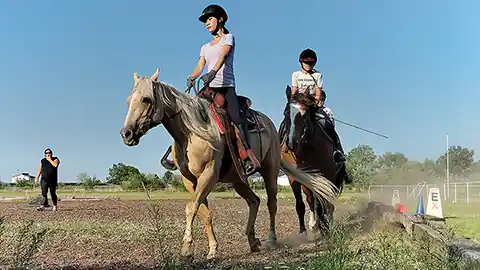
The dream of moving elegantly and harmoniously with a horse fascinates people of all ages. But anyone who starts riding quickly realizes: riding is not a passive "being carried," but a highly complex sport that requires empathy, body control, and a deep understanding of another living being.
Learn the difference quickly: A horse is a living being, not a piece of sports equipment. You will either learn and accept this beforehand, or your horse will teach you in a potentially rather unpleasant way.
For aspiring recreational riders, the first step is finding a common language with the horse. Here you'll learn which basic skills are essential, how modern technology is revolutionizing the process, and what your first lessons in the saddle will be.
©
R. Vidmar (echonet)Basic: Horse riding is more than just sitting around
Before even getting to the gaits of trot or canter, three fundamental pillars must be internalized - these are also the things you will be confronted with again and again in riding lessons, so memorize them well:
Communication with "Helpers"
Horses don't understand human words, but they do understand the rider's body language. In the saddle, this is referred to as the aids, which must always work together:
Weight aids: By minimally shifting your own weight (e.g., onto your inner seat bone in a turn), you signal the direction to the horse.
Leg aids: Pressure from the calves drives the horse forward or limits its lateral movement.
Rein aids: They serve for fine-tuning, positioning the horse's head and – contrary to popular opinion – never for braking by simply pulling, but as a framework for the movement.
Balanced seat
The biggest challenge for novice riders is being able to decouple their own movements from those of the horse. The goal is the so-called "plumb seat": the rider's shoulder, hip, and heel form a vertical line. Only those who move freely in their hips with the horse's movement will not restrict its natural gait.
Safety and accident prevention
Understanding horse behavior is essential for learning to ride. As a prey animal, it reacts fearfully to unexpected stimuli (such as a rustling bush). Correct and safe handling on the ground, proper leading, and knowing how to react in an emergency are every rider's lifeline.
High-tech with a saddle: The riding simulator
Those learning to ride today don't necessarily have to get on a real horse for their first frustrating attempts. One of the most exciting developments in modern riding instruction is electronic riding simulators . These are offered at many locations, often not by riding schools or stables, but by other providers. These are also frequently found in large cities, as the riding simulator is usually located on the provider's premises.
These life-size, artificial horses are equipped with highly sensitive sensors on the reins, in the saddle area, and on the flanks (for the legs). They mechanically replicate the movements of all gaits – from walk to trot to canter – perfectly.
Why does a simulator help enormously with learning?
No stress for the horse: A real horse often reacts with stress or becomes desensitized to an insecure beginner who stumbles around in the saddle. On the simulator, you can make mistakes without hurting an animal.
Instant visual feedback: The sensors transmit your weight and rein aids directly to a screen. You see immediately in black and white: "I'm pulling too hard on the left" or "I'm sitting crooked, tilted to the right."
Focus on your own body: Because the simulator doesn't shy away, buck, or maintain the exact speed you set, the riding student can concentrate 100% on their own breathing, posture, and balance. This drastically shortens the learning phase for a correct seat.
Digital Billboard

©
horseback-riding.net1. Placement: € 138 / Year
Digital advertising for a sensational price with a static link for your do-follow-dreams is available here. Get your customers here, let your business grow with us. It's: First come, first serve!
Online-Ads Horses & Riding©
horseback-riding.net2. Placement: € 148 / Year
Digital advertising for a sensational price with a static link for your do-follow-dreams is available here. Get your customers here, let your business grow with us. It's: First come, first serve!
Online-Ads Horses & RidingImportant lessons for recreational riders
Once the balance at the walk and trot is reasonably secure, it's time to move on to the first real lessons. For recreational riders, the focus is not on complicated dressage figures, but rather on control, gymnastic exercises, and safety in the arena and later on trails.
Correct halt and formation (parades)
The most important lesson of all: being able to bring the horse to a controlled stop at any time and to start riding again. Here the student learns that a horse is slowed down using the rider's seat (body tension) and leg aids – and that the reins only provide the final, gentle cue.
Large and small turns (track figures)
Riding curves (such as "full circle", "circles" or "voltes") trains the coordination of the aids. The rider learns the concept of "inside" and "outside": The inside leg drives the horse into the bend, the outside leg and rein prevent the horse from breaking out with its hindquarters or shoulder.
Relief seat (light seat)
This lesson is essential, especially for aspiring recreational riders who plan to ride out in the countryside later. It involves lifting the seat slightly out of the saddle and shifting more weight into the stirrups, while leaning the upper body slightly forward. This relieves pressure on the horse's back when riding over uneven terrain or uphill and provides optimal preparation for riding in open country.
Backing up the horse
A wonderful exercise in obedience and gymnastic training. The horse yields to a combination of subtle rein and driving leg aids, backing up. This requires trust and shows whether the communication between rider's hand and horse's mouth is already harmonious.
Learn to ride now...
Learning to ride is a journey that requires patience. Whether you take your first steps on a modern simulator or start directly on the lunge line of a well-behaved school horse, the most important thing is the willingness to work on your own fitness and coordination. Those who internalize the basic knowledge and fundamental lessons with respect for their equine partner will find themselves on the door to one of the world's most beautiful hobbies.
More on Horseback Riding...

©
Gerhard Bögner / pixabay.com SourceGet to know Vienna!
Vienna, Bratislava, Prague and Budapest – four capital cities quite close to each other. Get to know the centrope region, enjoy your stay there and find the most amazing places in this area. Regiotours will help you!
Enjoy the region...
©
R. Vidmar (echonet)Learn Horseback Riding
Why not enjoy the ride on a horse? Not only to go anywhere specific, just try it out. Learn horseback riding, a great way to relax, to do sports and of course to learn. Feel the saddle, enjoy your ride and find a stable!
Riding SchoolsMistake on the site?
If you see a mistake on our page about horseback riding and horses on our website horseback-riding.net or specifically on the subpage with the headline Fine interplay: Learn horse riding! we're looking forward to your mail. Please feel free to contact our Content-Team and tell us about our mistake so we can correct it as fast as possible. Thank you!