History of Dressage Riding
From the Battlefield to the Arena: The Military Purpose: A cavalry horse had to be highly maneuverable, responsive to weight aids, and capable of explosive, controlled movements to keep the rider alive in hand-to-hand combat.
Origins in Quadrilles
Dressage has its roots in what were known as "carrousels" or "horse ballets." These correspond to the quadrilles performed by riding clubs today. The sport's history—specifically as a competitive discipline—traces back to Slovakia. It was in Bratislava (historically known as *Pressburg*) that the first individual riding competition was held to award prizes for well-trained "Champagne horses." This inaugural dressage competition took place in 1873, organized by the "Society for the Awarding of Prizes to Well-Trained Champagne Horses", also based in Bratislava.
After the fall of the Roman Empire, classical training waned but experienced a massive revival during the Renaissance.
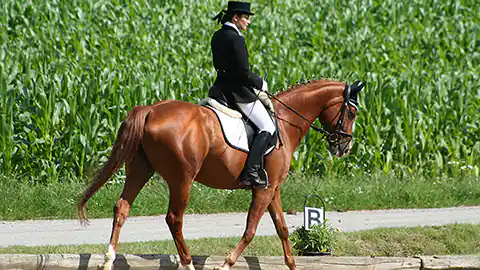
In the 16th century, academies sprouted across Europe, most notably the Spanish Riding School in Vienna (founded in 1572). Here, the focus shifted from brutal battlefield training to an art form. Aristocrats studied classical riding to demonstrate absolute control, symmetry, and grace. It was during this era that the spectacular Airs above the ground (like the Levade and Capriole) were perfected.
©
R. Vidmar (echonet)Olympic Status: Dressage Since 1912
Dressage made its Olympic debut in 1912 at the Games held in Sweden, where Carl Bonde won the gold medal riding his horse, Emperor. Sweden continued to dominate subsequent Olympic dressage competitions. The country won gold again at the 1920 Games in Antwerp (Netherlands) and once more at the 1924 Games in Paris. It took about 40 years for dressage to be included as an Olympic sport. The discipline originated from the requirements of European cavalry units; consequently, the regulations for Olympic competitions were modeled on these standards. Once a sport practiced exclusively by military officers—and thus naturally a male-dominated field—dressage is today a sport dominated by women. The rules changed in 1952 for the Helsinki Games, finally allowing civilian riders and women to compete. This sparked a massive shift in the sport's accessibility and global popularity.
Digital Billboard

©
horseback-riding.net1. Placement: € 138 / Year
Digital advertising for a sensational price with a static link for your do-follow-dreams is available here. Get your customers here, let your business grow with us. It's: First come, first serve!
Online-Ads Horses & Riding©
horseback-riding.net2. Placement: € 148 / Year
Digital advertising for a sensational price with a static link for your do-follow-dreams is available here. Get your customers here, let your business grow with us. It's: First come, first serve!
Online-Ads Horses & RidingEuropean Dominance in Dressage
Between 1912 and 2016, the gold medal effectively passed exclusively between European nations—a group that must also include the Union of Soviet Socialist Republics (USSR). No country outside the European continent managed to win the Olympic gold medal in dressage. The nations that have produced Olympic dressage gold medalists include France, Germany, Austria, Switzerland, the Netherlands, and Great Britain, as well as the USSR and Sweden. Notably, until 1968, the gold medal was won exclusively by men; since the 1972 Olympic Games in Munich, only women have won the gold medal.
More on Horseback Riding...

©
Gerhard Bögner / pixabay.com SourceGet to know Vienna!
Vienna, Bratislava, Prague and Budapest – four capital cities quite close to each other. Get to know the centrope region, enjoy your stay there and find the most amazing places in this area. Regiotours will help you!
Enjoy the region...
©
R. Vidmar (echonet)Learn Horseback Riding
Why not enjoy the ride on a horse? Not only to go anywhere specific, just try it out. Learn horseback riding, a great way to relax, to do sports and of course to learn. Feel the saddle, enjoy your ride and find a stable!
Riding Schools
©
R. Vidmar (echonet)Enjoy Cuba instead of Hurry Cuba
See the beautiful cities of Cuba, enjoy your rides, visit great tobacco farms and be guided by locals. Why more and more people use the service these european guys startet? Well, because they are into the service idea.
Transfers in Cuba
©
Milan Markovic / Can Stock Photo Inc. (07022017)Performing Events?
Get your event done and create professional invitations. Resending invitations to people who did not react, try the check-in-system or manage the plus ones of your guests. A ready 2 go solution by echonet.
Guestlist ManagementMistake on the site?
If you see a mistake on our page about horseback riding and horses on our website horseback-riding.net or specifically on the subpage with the headline History of Dressage Riding we're looking forward to your mail. Please feel free to contact our Content-Team and tell us about our mistake so we can correct it as fast as possible. Thank you!