The Art of Dressage: From the Battlefield to the Grand Prix in the Spotlight of Criticism
Dressage is considered the pinnacle of the partnership between horse and rider. Anyone watching a Grand Prix freestyle at the Olympic level sees a horse seemingly weightless, moving as if by magic, as it dances through the arena. Behind this lightness, however, lie years of meticulous training, a centuries-old tradition – and, in recent years, an increasingly emotional debate about the animal's welfare.
Historical Development: From Struggle for Survival to Art Form
Paradoxically, the roots of dressage lie not in aesthetics, but in the harsh reality of war. As early as ancient Greece, the general Xenophon (c. 430–354 BC) recognized that a horse is only useful in battle if it is rideable, agile, and absolutely obedient. His treatise On Horsemanship is considered the first standard work on non-violent horse training.
With the advent of firearms, cavalry lost its military significance, but horsemanship survived in the European courts of the Renaissance and Baroque periods. In institutions like the Spanish Riding School in Vienna (founded in 1565), the training of horses was elevated to a pure art form. Exercises such as the piaffe (trotting in place) and the capriole (a spectacular leap into the air) originated directly from the defensive maneuvers of Baroque warfare.
In the 20th century, academic horsemanship finally transformed into modern competitive sport. Since 1912, dressage has been a regular event at the Olympic Games.
©
R. Vidmar (echonet)Structure of the Sport: Classes and Competitions
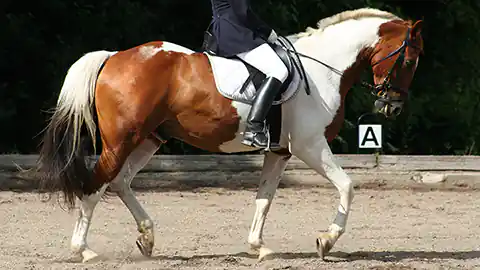
Today, dressage in competitive events is divided into various performance classes, ranging in Germany from E (beginner) through A (novice), L (light), and M (medium) to the highest class, S (advanced).
Riders compete in a standardized arena (20 x 40 meters for lower classes, 20 x 60 meters for advanced levels). Letters around the perimeter of the arena serve as reference points, indicating precisely defined movements that must be performed.
Important International Competitions
In top-level international dressage (Grand Prix level), there are three main tests:
- Grand Prix: The most difficult standardized test in the world. It includes all the classical advanced movements such as flying changes (changing leads from one leg to the other at every second or third stride), pirouettes, passage, and piaffe.
- Grand Prix Special: An even more precise and athletic sequence of the most difficult movements, with a focus on transitions.
- Grand Prix Freestyle: The absolute crowd-pleaser. The riders create their own sequence of movements and accompany them with perfectly chosen music. Both technical execution and artistic presentation are judged.
Digital Billboard

©
horseback-riding.net1. Placement: € 138 / Year
Digital advertising for a sensational price with a static link for your do-follow-dreams is available here. Get your customers here, let your business grow with us. It's: First come, first serve!
Online-Ads Horses & Riding©
horseback-riding.net2. Placement: € 148 / Year
Digital advertising for a sensational price with a static link for your do-follow-dreams is available here. Get your customers here, let your business grow with us. It's: First come, first serve!
Online-Ads Horses & RidingSport Under Fire: Criticism and Animal Welfare Debates
Despite its enduring appeal, dressage is facing unprecedented criticism today. Animal rights activists, veterinarians, and even voices within the equestrian world itself are increasingly questioning the training methods and judging systems used in modern elite sport.
Hyperflexion ("Rollkur")
Perhaps the most controversial topic in dressage is the so-called »rollkur« (artificial hyperextension of the horse's neck downwards and backwards). This involves pulling the horse's head extremely close to its chest through excessive rein pressure.
The criticism: This posture severely restricts the horse's field of vision, impairs its breathing, and leads to chronic damage to the cervical spine and muscles. Although the German Equestrian Federation (FN) and the International Equestrian Federation (FEI) have banned the method in its extreme form, gray areas are still frequently observed in the warm-up arenas of international competitions.
Coercion Instead of Harmony
Critics complain that the judging systems often reward spectacular, unnatural movements (such as extreme "pawing" with the front legs) with high marks, even when the horse is visibly stressed (recognizable by wide eyes, constantly swishing tail, or an open mouth). The actual goal of dressage—relaxation and the horse's voluntary cooperation—is thus relegated to the background.
Blue Tongues and Behavioral Problems
Time and again, undercover reports or close-up shots of competitions uncover abuses: bridles fastened too tightly, making it impossible for the horse to chew, or injuries in the mouth ("blue tongues" due to insufficient blood flow caused by excessive rein pressure).
Outlook for Dressage Riding: A Sport in Transition
Dressage is at a turning point. To avoid losing its social acceptance ("social license"), the federations are increasingly taking action. Controls in the warm-up arenas have been tightened; bridle and bit checks immediately after the test are now standard practice, and judges are encouraged to more consistently penalize signs of stress in horses with point deductions.
The future of dressage will depend on whether it succeeds in returning the sport to its harmonious roots: a training that makes the horse more beautiful and proud, rather than breaking it.
More on Horseback Riding...

©
Gerhard Bögner / pixabay.com SourceGet to know Vienna!
Vienna, Bratislava, Prague and Budapest – four capital cities quite close to each other. Get to know the centrope region, enjoy your stay there and find the most amazing places in this area. Regiotours will help you!
Enjoy the region...
©
R. Vidmar (echonet)Learn Horseback Riding
Why not enjoy the ride on a horse? Not only to go anywhere specific, just try it out. Learn horseback riding, a great way to relax, to do sports and of course to learn. Feel the saddle, enjoy your ride and find a stable!
Riding Schools
©
R. Vidmar (echonet)Enjoy Cuba instead of Hurry Cuba
See the beautiful cities of Cuba, enjoy your rides, visit great tobacco farms and be guided by locals. Why more and more people use the service these european guys startet? Well, because they are into the service idea.
Transfers in Cuba
©
Milan Markovic / Can Stock Photo Inc. (07022017)Performing Events?
Get your event done and create professional invitations. Resending invitations to people who did not react, try the check-in-system or manage the plus ones of your guests. A ready 2 go solution by echonet.
Guestlist ManagementMistake on the site?
If you see a mistake on our page about horseback riding and horses on our website horseback-riding.net or specifically on the subpage with the headline Dressage Riding - Art and Criticism we're looking forward to your mail. Please feel free to contact our Content-Team and tell us about our mistake so we can correct it as fast as possible. Thank you!