Snaffle Bit: Fundamental Communication Tool in the Horse's Mouth
When thinking of horse tack, the image that immediately comes to mind is that of reins and the shiny piece of metal inside the horse's mouth: the snaffle bit. It is the most widely used bit in the world and forms the cornerstone of classical riding training.
We've to say in general for your understanding: Connected directly to the bridle's reins, the bit acts as a key communication tool rather than a mechanism for physical force. Its primary purpose is to transmit subtle hand signals from the rider to the horse's mouth, allowing for precise control over direction, speed, and head carriage. When used with a soft, educated hand, the bit helps guide the horse's balance and facilitates clear communication; however, its effectiveness and the horse's comfort depend entirely on the rider's skill, empathy, and proper equipment fitting.
While any type of bridle is often mistakenly referred to as a "snaffle" in everyday language, the term actually refers to a specific category of bits. But what defines a snaffle bit in general, how does it work, and why is it the foundation of modern equestrian sport?
What Is a Snaffle Bit? The Shared Principle
Regardless of its specific shape or material, all snaffle bits share one common characteristic: they act directly and without leverage.
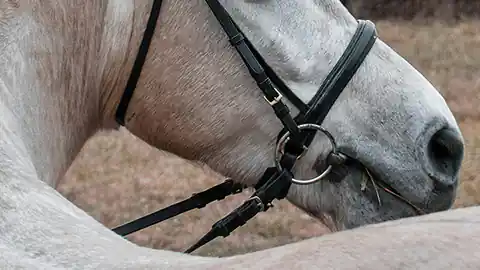
This means that the pressure the rider applies via the reins is transmitted to the horse's mouth at a 1:1 ratio. There is no mechanical amplification of force, as occurs with a curb bit or a Pelham bit, for example. The snaffle rests on the tongue within the gap between the horse's incisors and molars (known as the bars) and acts primarily on these two areas as well as the corners of the mouth.
©
Julien Mussard / Unsplash SourceOverview of the three basic Types of Bits
Although the principle of direct action remains constant, the family of snaffle bits is divided into three main design types, each creating a distinct dynamic within the horse's mouth:
1. Jointed snaffles (single or double-jointed)
These are the most common models. Featuring one or two metal joints, the bit is flexible and conforms to the shape of the tongue.
Purpose: They allow for very precise, one-sided aids (e.g., when positioning and bending through turns), as the left and right sides of the bit can move independently to a certain degree.
2. Unjointed snaffles (straight bars/mullen mouth bits)
A snaffle bit does not necessarily have to be flexible. A straight-bar bit has no joints and rests in the mouth like a straight or slightly anatomically curved bar.
Purpose: One-sided rein aids are transmitted over a broader surface area because the bar moves as a single unit. For horses that are restless in the mouth or have sensitive tongue edges, it often provides a very stable and even bearing surface.
3. Snaffles with lateral guidance (eggbutt, D-ring, full-cheek)
In these models, the rein rings are designed to sit fixed against the mouthpiece or are restricted by long metal bars (cheeks).
Purpose: They prevent the bit from sliding through the mouth under strong one-sided pull and gently frame the horse from the outside—ideal for training young horses or for use in show jumping courses.
The Importance of Snaffle Bits in Equestrian Sport and Training
In classical riding theory, the snaffle bit is indispensable. It is the only type of bit that should be used during the training of young horses (*remontes*). Why? Because it guides the horse directly toward the rider's hand without inciting fear of painful leverage action.
Even in competitive sport, the snaffle remains the standard bit used up to the highest levels of competition. It demands honest riding from back to front (connecting the seat to the hand) and immediately reveals any errors in hand usage.
Safety and Responsibility
Although the snaffle is considered a "mild" bit compared to the curb bit, its gentleness depends entirely on the rider's hand. Uncontrolled pulling or jerking can cause even a snaffle to exert painful pressure on the sensitive bars of the horse's mouth.
Therefore, the specific choice of snaffle should always be tailored to the individual anatomy of the horse's mouth (tongue thickness, palate height) and the training level of both horse and rider.
Digital Billboard

©
horseback-riding.net1. Placement: € 138 / Year
Digital advertising for a sensational price with a static link for your do-follow-dreams is available here. Get your customers here, let your business grow with us. It's: First come, first serve!
Online-Ads Horses & Riding©
horseback-riding.net2. Placement: € 148 / Year
Digital advertising for a sensational price with a static link for your do-follow-dreams is available here. Get your customers here, let your business grow with us. It's: First come, first serve!
Online-Ads Horses & RidingAn Overview of Snaffle Bits
In addition to the classic loose-ring snaffle, there is a wide range of other snaffle and bit designs in equestrian sport. They differ primarily in how steadily they sit in the horse's mouth, the amount of pressure they exert on specific areas (such as the corners of the mouth or the bars), and whether they utilize leverage. We have compiled the most important models for you here.
1. Bits with mechanical stops (lateral guidance aids)
These models prevent the bit from being dangerously pulled through the horse's mouth and provide additional lateral guidance.
- Eggbutt snaffle: With this bit, the rings are fixed to the mouthpiece (often featuring a small, egg-shaped joint). Since the rings do not slide freely through the bit, it sits extremely steadily in the mouth, protects the corners of the mouth from pinching, and offers slight lateral guidance during turns. D-ring snaffle: The outer rings are shaped like a large "D." The straight side of the D-ring lies flat against the horse's cheeks. This provides the horse with very clear visual and physical guidance when the rider changes direction. Very popular for young horses and in show jumping.
- Full-cheek snaffle: This bit features long metal bars (cheeks or "knebels") attached to the rings. They are highly effective at preventing the bit from being pulled through the mouth and, when the reins are pulled, exert gentle pressure on the outer cheek to guide the horse into a turn.
2. Bits with leverage action or pressure redistribution
These bits utilize physical leverage to direct pressure not only onto the tongue but also onto the poll or the curb chain.
- Pelham: A combination of a snaffle and a curb bit. It features a straight or jointed mouthpiece, side shanks (leverage arms), and a curb chain. It can be ridden with two pairs of reins or with a single pair of reins combined with a connecting strap (Pelham roundings). It is frequently used in show jumping or hunting.
- Baucher bit & Elevator bit: These bits feature additional small rings positioned above or below the main ring. When the reins are pulled, the bit slides slightly upward, creating distinct pressure on the horse's poll via the cheekpieces. This helps with horses that tend to lean heavily downward onto the bit.
- Kimblewick: Visually similar to a D-ring bit, but featuring small slots or notches inside the ring where the reins are attached. Used in conjunction with a curb chain, it creates a mild leverage effect and is a popular choice for children riding strong ponies.
3. Bits for specific disciplines
There are also specialized snaffle bits designed for particular riding disciplines—though this list cannot claim to be exhaustive, as new innovations frequently appear that cannot be anticipated here.
- Western bits (e.g., Western snaffle): Western riding often employs bits with slightly flattened or distinctively shaped rings; while functionally similar to the standard loose-ring snaffle, their appearance and balance are tailored to the Western style.
- Under-bridle snaffle (bradoon): This is a specialized, exceptionally thin loose-ring snaffle with very small rings. It is used exclusively in conjunction with a curb bit within a double bridle setup, as two standard-thickness bits simply would not fit comfortably in the horse's mouth.
4. The "Mullen mouth" (Unjointed bit)
Unlike single- or double-jointed snaffles, the mullen mouth bit has no joint in the center. It rests on the tongue like a straight or slightly anatomically curved bar. Rein aids act simultaneously on both sides and across a large surface area of the tongue, making one-sided steering more difficult.
More on Horseback Riding...

©
Gerhard Bögner / pixabay.com SourceGet to know Vienna!
Vienna, Bratislava, Prague and Budapest – four capital cities quite close to each other. Get to know the centrope region, enjoy your stay there and find the most amazing places in this area. Regiotours will help you!
Enjoy the region...
©
R. Vidmar (echonet)Learn Horseback Riding
Why not enjoy the ride on a horse? Not only to go anywhere specific, just try it out. Learn horseback riding, a great way to relax, to do sports and of course to learn. Feel the saddle, enjoy your ride and find a stable!
Riding Schools
©
R. Vidmar (echonet)Enjoy Cuba instead of Hurry Cuba
See the beautiful cities of Cuba, enjoy your rides, visit great tobacco farms and be guided by locals. Why more and more people use the service these european guys startet? Well, because they are into the service idea.
Transfers in Cuba
©
Milan Markovic / Can Stock Photo Inc. (07022017)Performing Events?
Get your event done and create professional invitations. Resending invitations to people who did not react, try the check-in-system or manage the plus ones of your guests. A ready 2 go solution by echonet.
Guestlist ManagementMistake on the site?
If you see a mistake on our page about horseback riding and horses on our website horseback-riding.net or specifically on the subpage with the headline Bridles for Riding: Classic Bits for the Horse's Mouth we're looking forward to your mail. Please feel free to contact our Content-Team and tell us about our mistake so we can correct it as fast as possible. Thank you!