Jack-of-All-Trades: Mastering the General-Purpose Saddle
If you have ever taken a lesson at a riding school or rented a horse for a trail ride, chances are you have sat in an all-purpose saddle (also known as a General Purpose or GP saddle). First of all, we want to give you a quick summary for this topic:
The all-purpose or general purpose saddle is the unsung hero of the equestrian world. While it won't take you to the Olympics in dressage or grand prix show-jumping, it provides the perfect, safe, and comfortable foundation for beginners to explore the sport. It protects the horse's back, keeps the rider secure, and opens the door to every discipline the horse world has to offer.
As the absolute staple of riding academies and the go-to choice for beginners, this versatile piece of equipment is designed to do exactly what its name implies: bridge the gap between flatwork and jumping. But what makes this saddle so popular, how does it influence your position in the stirrups, and what should you look for when buying one? Here is your complete guide.
©
Gustavo Fring / Pexels SourceSpecifics of a GP-Saddle
The all-purpose saddle is a deliberate engineering compromise. It sits exactly halfway between the specialized worlds of dressage and show-jumping.
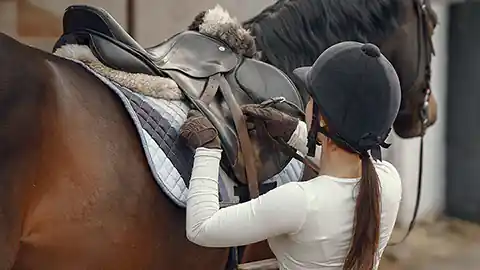
Unlike a dressage saddle (which forces a long, straight leg) or a jumping saddle (which requires a short, bent knee), the GP saddle features a moderately forward-cut flap. The seat is of medium depth, providing a secure, comfortable cradle without locking the rider into a rigid position. It allows you to comfortably lengthen your stirrups for a flatwork lesson on Tuesday, and shorten them by a few holes to pop over a line of fences on Thursday.
Anatomy of an All-Purpose Saddle: The Parts to Know
Understanding the components of your saddle helps with proper use and communication with trainers or saddle fitters.
- The Tree: The internal skeleton (made of wood/steel or synthetic polymers) that gives the saddle its structural shape.
- The Pommel: The rounded front arch that sits over the horse's withers.
- The Cantle: The gently sloped back arch of the seat.
- The Seat: The lowest point where the rider's pelvis rests.
- The Flaps & Knee Rolls: The leather side panels featuring medium-sized padded blocks underneath to stabilize the rider's knee.
- The Panels: The cushions underneath the saddle (usually stuffed with wool flocking or foam) that rest directly on the horse's back.
- The Billets: Medium-length leather or synthetic straps used to buckle a standard-length riding girth.
Digital Billboard

©
horseback-riding.net1. Placement: € 138 / Year
Digital advertising for a sensational price with a static link for your do-follow-dreams is available here. Get your customers here, let your business grow with us. It's: First come, first serve!
Online-Ads Horses & Riding©
horseback-riding.net2. Placement: € 148 / Year
Digital advertising for a sensational price with a static link for your do-follow-dreams is available here. Get your customers here, let your business grow with us. It's: First come, first serve!
Online-Ads Horses & RidingMaterials: Leather vs. Synthetics
Because all-purpose saddles are heavily utilized in riding schools, durability and maintenance are top priorities. They are generally manufactured in two variants:
- Synthetic Materials (e.g., Nylon, Vinyl, Faux-Suede): Brands like Wintec or Bates dominate the beginner market. Synthetics are lightweight, highly budget-friendly, and completely weatherproof. If they get muddy or sweaty, you can literally hose them off. This makes them the ultimate choice for busy riding schools.
- Traditional Leather: Offers a classic look, incredible longevity if oiled regularly, and molds beautifully to both the horse's shape and the rider's anatomy over time. They are, however, heavier and more expensive.
How the GP-Saddle Effects the Rider and the Horse
Rider: The Safety Cushion
For beginners, the GP saddle provides a massive confidence boost. The medium-deep seat and supportive knee rolls offer excellent security if a horse stumbles, spooks, or unexpectedly bucks.
However, it introduces a biomechanical drawback known as the "chair seat." Because the stirrup bars are placed slightly forward to allow for jumping, the saddle naturally pulls the rider's legs forward. This makes it highly comfortable for casual trail riding, but physically difficult to achieve the perfect vertical alignment (shoulder-hip-heel) required for advanced dressage.
Horse: Balanced Weight Distribution
For the horse, a GP saddle features broad, supportive panels that distribute weight evenly over the back muscles. Because the flaps are only moderately forward, they keep the horse's shoulder blades relatively free during low jumps while ensuring the saddle doesn't extend too far back onto the fragile lumbar spine. It is a highly comfortable "everyday" fit for a wide variety of horse breeds.
Four Tips for Buying an General-Purpose (GP) Saddle
If you are looking to purchase your first GP saddle, keep these crucial tips in mind:
- Prioritize an Adjustable Gullet: Many modern synthetic GP saddles come with interchangeable gullet systems. Since beginners often lease horses or ride different school animals, an adjustable tree allows you to change the saddle's width to fit different horses safely.
- Look for Moveable Velcro Blocks: Select a saddle where the knee and thigh blocks under the flap are attached via Velcro. This allows you to position the blocks precisely where your leg naturally falls, preventing your knee from getting cramped.
- Test the Seat Depth: Some GP saddles lean more toward jumping (GP-Jump), while others lean toward dressage (GP-Dressage). Sit in a few different models to find whether you prefer a slightly flatter or deeper seat.
- Don't Skip the Fitter: Even an "all-purpose" saddle is useless if it pinches your horse. Always have a certified saddle fitter check the wool flocking and balance before finalizing your purchase.
More on Horseback Riding...

©
Gerhard Bögner / pixabay.com SourceGet to know Vienna!
Vienna, Bratislava, Prague and Budapest – four capital cities quite close to each other. Get to know the centrope region, enjoy your stay there and find the most amazing places in this area. Regiotours will help you!
Enjoy the region...
©
R. Vidmar (echonet)Learn Horseback Riding
Why not enjoy the ride on a horse? Not only to go anywhere specific, just try it out. Learn horseback riding, a great way to relax, to do sports and of course to learn. Feel the saddle, enjoy your ride and find a stable!
Riding Schools
©
R. Vidmar (echonet)Enjoy Cuba instead of Hurry Cuba
See the beautiful cities of Cuba, enjoy your rides, visit great tobacco farms and be guided by locals. Why more and more people use the service these european guys startet? Well, because they are into the service idea.
Transfers in Cuba
©
Milan Markovic / Can Stock Photo Inc. (07022017)Performing Events?
Get your event done and create professional invitations. Resending invitations to people who did not react, try the check-in-system or manage the plus ones of your guests. A ready 2 go solution by echonet.
Guestlist ManagementMistake on the site?
If you see a mistake on our page about horseback riding and horses on our website horseback-riding.net or specifically on the subpage with the headline General-Purpose Saddle: Anatomy, Pros & Cons we're looking forward to your mail. Please feel free to contact our Content-Team and tell us about our mistake so we can correct it as fast as possible. Thank you!