Engineered for Flight: The Ultimate Guide to Show-Jumping Saddles
In the world of equestrian sports, few moments match the thrill of a horse and rider clearing a massive fence in perfect harmony. While training, athleticism, and trust are paramount, the rider's equipment plays an indispensable structural role. At the heart of this connection is the show-jumping saddle (often simply called a close-contact saddle).
Engineered specifically for the mechanics of jumping, this specialized piece of tack is designed to support the rider’s balance in mid-air while giving the horse maximum freedom to clear obstacles.
Lets say it this way: A show-jumping saddle is a highly evolved piece of athletic equipment. By prioritizing a flat seat, forward flaps, and close contact, it grants the horse the freedom to use its entire body over a fence while offering the rider the exact safety levers needed to stay secure upon landing.
If jumping is your passion, investing in a true close-contact saddle isn't just about performance—it is a vital step toward protecting your horse’s back and ensuring your safety in the air.
©
Enrico Motta / Unsplash SourceWhat Makes a Show-Jumping Saddle Specific?
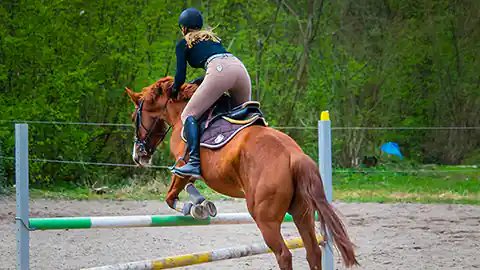
A jumping saddle is instantly recognizable by its distinct geometry, which is heavily adapted to the forward, crouched position (the two-point or jumping seat) that riders assume over fences.
- Forward-Cut Flaps: Unlike flat or vertical flaps, jumping flaps angle dramatically forward. This design accommodates the rider's shorter stirrup length, keeping the knees securely positioned against the saddle without riding up over the front edge.
- Flat, Low Cantle: The back of the saddle (the cantle) is notably flat and low-profile. This prevents the saddle from hitting the rider in the seat when they shift their weight backward before a jump or push forward over a fence.
- The Close-Contact Twist: The "twist" (the narrowest part of the seat where the rider's thighs rest) is designed to be very narrow. Combined with minimal padding under the leg, this brings the rider’s thighs and calves as close to the horse's barrel as possible for ultra-precise communication.
- Strategic Blocks: Jumping saddles feature knee and thigh blocks (prominent pads underneath or on top of the flap) to act as a supportive brace, securing the rider's leg during rapid accelerations, sharp turns, or awkward landings.
Advantages and Disadvantages of Jumping Saddles
Advantages for Showjumping with Horses
- Maximum Freedom for the Horse’s Shoulder: Jumping saddles are built to sit slightly further back, and the panels are shaped to allow the horse’s shoulder blades to rotate freely backward and upward when snapping their front legs up over a rail.
- Enhanced Rider Security in Mid-Air: The forward knee rolls and blocks stabilize the lower leg, ensuring the rider doesn't slip backward upon landing.
- Unobstructed Weight Shifts: The flat seat allows the rider to effortlessly slip out of the saddle into a two-point position and fluidly return to it without getting caught on the cantle.
Disadvantages of these Horse Saddles
- Lack of Support on the Flat: Because the seat is so flat and the stirrups are short, sitting deep for a long period in a working trot can be uncomfortable and physically exhausting for the rider's core and lower back.
- Poor Longitudinal Weight Distribution: Because the panels are shorter to accommodate the shoulder, they distribute the rider's weight over a slightly smaller surface area on the horse's back compared to long endurance or dressage saddles.
Digital Billboard

©
horseback-riding.net1. Placement: € 138 / Year
Digital advertising for a sensational price with a static link for your do-follow-dreams is available here. Get your customers here, let your business grow with us. It's: First come, first serve!
Online-Ads Horses & Riding©
horseback-riding.net2. Placement: € 148 / Year
Digital advertising for a sensational price with a static link for your do-follow-dreams is available here. Get your customers here, let your business grow with us. It's: First come, first serve!
Online-Ads Horses & RidingDisciplines Compared: Jumping vs. Dressage vs. All-Purpose
To understand why specialized tack matters, it helps to see how the jumping saddle stacks up against its closest relatives:
| Feature | Show-Jumping Saddle | Dressage Saddle | All-Purpose (GP) Saddle |
|---|---|---|---|
| Seat Depth | Flat to semi-flat | Very deep | Medium |
| Flap Shape | Strongly forward-cut | Long, straight, and vertical | Moderately forward |
| Cantle Height | Low and square | High and prominent | Medium |
| Stirrup Length | Short (for spring and balance) | Long (for a deep, draped leg) | Medium (versatile) |
| Primary Goal | Freedom over fences | Deep seat & precise flatwork | General recreation / low fences |
Why You Shouldn't Use a Dressage or All-Purpose Saddle for Jumping
It can be tempting for riders starting out in multiple disciplines to use one saddle for everything. However, taking a dressage or standard all-purpose saddle over significant fences poses real physiological and safety risks.
The Danger of Using a Dressage Saddle for Jumping
Attempting to jump in a dressage saddle is highly counterproductive—and dangerous.
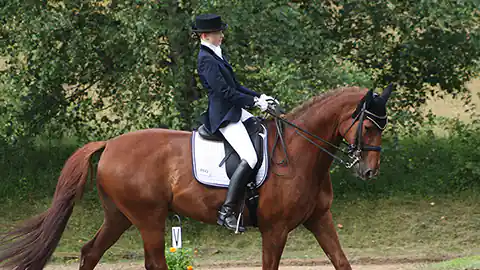
- The Flap Conflict: Because dressage flaps are completely straight, shortening your stirrups to a jumping length forces your knees entirely off the front of the saddle, leaving your leg with zero support or grip.
- The Cantle Trap: The deep seat and high cantle of a dressage saddle are designed to lock you into the lowest point of the horse's back. When a horse launches over a fence, its hindquarters rise rapidly. A high cantle will physically strike the rider in the buttocks, violently launching them forward over the horse’s neck or unbalancing the horse mid-flight.
- Shoulder Restriction: The long, straight panels of a dressage saddle can severely pinch the horse's shoulders when they attempt to bascule (round their body) over a fence.
The Limits of an All-Purpose (General Purpose) Saddle
While an All-Purpose (AP) saddle is great for hacking and tiny cross-poles, it quickly reaches its limits as fences get higher ($90\text{ cm}$ or higher).
- The Compromise Trap: An AP saddle is a jack-of-all-trades but a master of none. The flaps are only moderately forward. As your stirrups get shorter for higher jumps, your knee will begin to override the knee rolls.
- Balance Displacement: AP saddles tend to place the rider’s center of gravity slightly too far back for an optimal jumping position, making it difficult to stay effortlessly "with the motion" of a powerful equine athlete.
Mistake on the site?
If you see a mistake on our page about horseback riding and horses on our website horseback-riding.net or specifically on the subpage with the headline Show-Jumping Saddle Guide: Features & Perks we're looking forward to your mail. Please feel free to contact our Content-Team and tell us about our mistake so we can correct it as fast as possible. Thank you!