The Ultimate Guide to Horse Riding Saddles: Types, Materials, and Fit
For thousands of years, the saddle has served as the vital, structural bridge between horse and rider. Far more than just a place to sit, a correctly designed saddle distributes the rider’s weight evenly across the horse’s back muscles, protecting its spine while allowing the rider to communicate with precision.
Let's go all in and we give you a short conclustion about horse riding saddles: Your saddle is the most important investment you will make outside of purchasing the horse itself. By choosing the right discipline type, selecting materials that suit your lifestyle, and strictly prioritizing a flawless anatomical fit, you protect your horse's physical health and pave the way for a comfortable, successful riding partnership.
Whether you are a beginner looking to understand the gear or a seasoned equestrian searching for your next upgrade, here is everything you need to know about saddle types, materials, anatomy, and fitting.
Overview: The Main Types of Horse Saddles
Different equestrian disciplines require vastly different riding positions. Saddles have evolved into highly specialized tools tailored to these distinct movements.
Dressage Saddles
- The Design: Features a deep seat, a high back (cantle), and long, completely straight, vertical flaps.
- The Purpose: Designed for flatwork. It encourages the rider to sit with a deeply draped, long leg and an upright posture, allowing for micro-signals through the seat and thighs.
Show-Jumping Saddles
- The Design: Features a flat seat, a low-profile cantle, and flaps that angle dramatically forward.
- The Purpose: Built for riding with short stirrups over fences. It allows the rider to easily shift into a crouched "two-point" position without getting caught on the seat, while giving the horse's shoulders total freedom to jump.
All-Purpose (or General Purpose) Saddles
- The Design: The middle ground. It features a medium-deep seat and moderately forward flaps.
- The Purpose: Ideal for recreational riders who enjoy a bit of everything—trail riding, basic dressage, and low jumps. It is a jack-of-all-trades but master of none.
Western Saddles
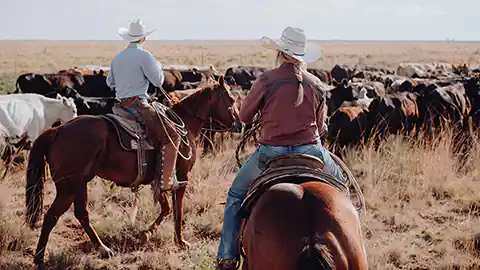
- The Design: Heavy, broad, and deeply padded with a prominent horn at the front and high cantle at the back. It distributes weight over a massive surface area.
- The Purpose: Originally designed for cowboys working cattle all day. It offers maximum comfort for long hours in the sun and stability during sharp cattle-herding maneuvers.

©
Bailey Alexander / Unsplash SourceAnatomy of a Horse Saddle: Key Parts to Know
To talk intelligently about saddles, every rider should know the foundational anatomy of the gear:
- The Tree: The rigid internal skeleton of the saddle (hidden under the leather) that determines its shape and width.
- The Pommel & Cantle: The front (pommel) and back (cantle) arches of the seat.
- The Gullet: The open channel running underneath the saddle that keeps the spine and withered area free from pressure.
- The Flaps: The large leather panels on the sides where the rider's legs rest.
- The Panels: The stuffed cushions on the underside of the saddle that directly rest on the horse's back muscles.
- The Billets: The sturdy leather straps hanging beneath the flap where the girth is buckled.
Digital Billboard

©
horseback-riding.net1. Placement: € 138 / Year
Digital advertising for a sensational price with a static link for your do-follow-dreams is available here. Get your customers here, let your business grow with us. It's: First come, first serve!
Online-Ads Horses & Riding©
horseback-riding.net2. Placement: € 148 / Year
Digital advertising for a sensational price with a static link for your do-follow-dreams is available here. Get your customers here, let your business grow with us. It's: First come, first serve!
Online-Ads Horses & RidingWhat is a Saddle Made Of?
Modern saddles are primarily categorized by two main outer materials, built over an internal structure.
The Internal "Tree"
Traditionally made of wood reinforced with steel, modern trees are increasingly made of lightweight, flexible synthetic polymers or fiberglass. Some innovative saddles are entirely "treeless," relying on thick padding for horses with specific back shapes.
Leather vs. Synthetic Exterior
Traditional Leather: Cowhide or pigskin remains the gold standard. It is incredibly durable, develops a beautiful patina, and molds to both the horse and rider over time. However, it requires tedious cleaning and conditioning.
Synthetic Materials: Made of high-tech nylons, faux-suede, or vinyl (e.g., Wintec). They are incredibly lightweight, weatherproof, budget-friendly, and can simply be hosed off to clean. They lack the long-term molding ability and prestige of real leather.
How to Find the Right Saddle for Your Horse + Pro-Tip!
An ill-fitting saddle is one of the leading causes of behavioral issues (bucking, biting when girthed) and severe back injuries in horses. Finding the perfect fit requires professional guidance, but you can check for these four core pillars:
- Wither Clearance: When the saddle is girthed up with a rider in it, there should be a gap of at least $2\text{ to }3$ fingers between the pommel and the horse's spine/withers (both on top and on the sides).
- Gullet Channel Width: The spine must never bear weight. The channel beneath the saddle must be wide enough to completely clear the horse's spinal column and the sensitive ligaments surrounding it.
- The Correct Tree Angle: The front points of the saddle tree must match the slope of the horse's shoulder. If the tree is too narrow, it will pinch the horse like a tight shoe; if it is too wide, the saddle will crash down onto the spine.
- Saddle Length: A saddle must never extend past the horse's 18th thoracic vertebra (the last rib). Any weight pressed onto the lumbar region (the lower back) causes immediate pain and cramping.
Pro Tip: Horses change shape constantly depending on their age, fitness level, and the season. Have a professional certified saddle fitter check your tack at least once a year to make adjustments to the wool flocking or tree width.



Mistake on the site?
If you see a mistake on our page about horseback riding and horses on our website horseback-riding.net or specifically on the subpage with the headline Horse Saddles 101: Types, Materials & Fit we're looking forward to your mail. Please feel free to contact our Content-Team and tell us about our mistake so we can correct it as fast as possible. Thank you!