Icons of the Frontier: The Mechanics of the Western Saddle
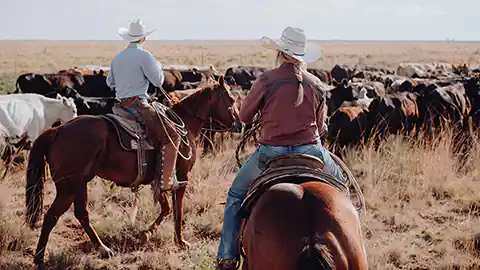
When you think of the American West, you instantly picture a cowboy herding cattle across wide-open plains. The defining gear of that image is the Western saddle.
Unlike English saddles, which evolved from military and aristocratic sporting traditions, the Western saddle was born as a rugged, functional workstation. It was engineered for vaqueros and cowboys who spent up to 12 hours a day on horseback, working cattle and conquering rough terrain.
What Makes a Western Saddle Specific?
The defining characteristic of a Western saddle is its massive surface area and structural weight distribution. It is significantly larger and heavier than any English counterpart—often weighing between $20\text{ and }40\text{ lbs}$ ($9\text{ to }18\text{ kg}$).
Every curve, strap, and piece of leather is optimized for three specific things: supreme rider comfort over vast distances, maximum stability during explosive cattle maneuvers, and distributing intense mechanical stress (like a roped steer pulling against the saddle).
©
Bailey Alexander / Unsplash SourceAnatomy of a Western Saddle: Key Specialized Parts
Because it was designed for working ranch hands, the anatomy of a Western saddle includes unique parts completely absent from English designs.
- The Horn: The most famous feature. Rising straight up from the front arch (the swells or fork), the horn was originally designed to dally (wrap) a lasso around when roping cattle. Today, even in non-cattle events, it serves as a secure anchor point.
- The Fender: Instead of thin English stirrup leathers, Western saddles feature a massive, wide sheet of leather running down the side called the fender. What it does: It completely shields the rider’s legs from the horse's sweat and prevents the stirrup straps from pinching the calves.
- The Skirt: Large, wool- or sheepskin-lined leather panels that extend far past the seat down the horse's back and sides.
- The Rigging (D-Ring): Heavy-duty steel rings built directly into the saddle tree. This is where the latigo (a long leather tie strap) connects to secure the cinch (the Western term for a girth).
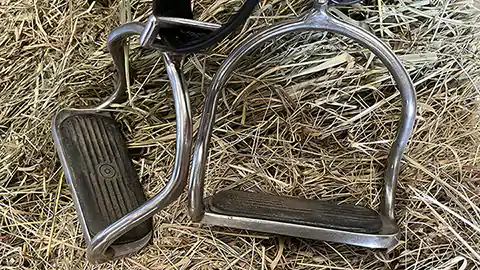
- The Stirrups: Deep, wide wooden or metal hoops, often covered in leather, designed to support heavy boots comfortably for hours without causing foot fatigue.
| Feature | Western Saddle | English Saddle (Dressage / Jumping / GP) |
|---|---|---|
| Primary Philosophy | Weight distribution & working stability | Close-contact & specialized body posture |
| Internal Tree | Large wood/fiberglass bars covering a wide area | Shorter, narrower rails focusing on specific muscles |
| Under-Padding | Relies on a thick wool/felt Western blanket | Features built-in stuffed panels (no thick pads needed) |
| Girth Style | Thick cinch tightened manually with a latigo loop | Narrow girth secured directly with metal buckles |
| Rider Leg Feel | Pushed away by thick leather fenders | Direct contact with the horse's ribs via thin flaps |
Digital Billboard

©
horseback-riding.net1. Placement: € 138 / Year
Digital advertising for a sensational price with a static link for your do-follow-dreams is available here. Get your customers here, let your business grow with us. It's: First come, first serve!
Online-Ads Horses & Riding©
horseback-riding.net2. Placement: € 148 / Year
Digital advertising for a sensational price with a static link for your do-follow-dreams is available here. Get your customers here, let your business grow with us. It's: First come, first serve!
Online-Ads Horses & RidingImpact on the horse
Because of the massive skirt and wide tree bars, a Western saddle distributes the rider's weight over a significantly larger surface area of the horse's back. This reduces localized pressure points, making it highly comfortable for long trail rides. However, because it covers so much territory, the tree must fit the horse's shoulder slope perfectly, or it will severely restrict turning and athletic movement.
Impact on the rider
The rider sits in a Western saddle rather than on it. The deep seat, high cantle at the back, and large swells at the front create a protective "cradle." It encourages a deep, relaxed seat with longer stirrups. You communicate primarily through neck-reining (one-handed steering) and shifting your body weight, rather than the constant, microscopic leg and hand contact used in dressage or show-jumping.
Tips for Buying a Western Saddle
- Know Your Sub-Discipline: Western riding isn't just one sport. A Roping saddle has an ultra-reinforced horn and heavy wood tree; a Reining saddle has a flatter seat to allow for sliding stops; a Barrel Racing saddle is lightweight with high swells to lock you into sharp turns; and a Trail saddle focuses entirely on maximum padding. Choose the saddle built for your specific hobby.
- Pay Attention to the Tree Size (Gullet): Western trees are generally categorized as Regular Quarter Horse Bars (RQHB) for narrower horses or Full Quarter Horse Bars (FQHB) for wider, stockier breeds. Getting this wrong will lead to severe wither pinching or bridging (where the saddle only touches the front and back of the horse, leaving a painful gap in the middle).
- Test the Fender Length: Western leather fenders can be quite stiff and long. Make sure the saddle you choose allows the stirrups to adjust short enough for your inseam—especially if you are a shorter rider or buying for a youth.
- Don't Skimp on the Saddle Pad: Unlike English saddles with built-in cushioning, Western saddles require a high-quality, thick felt or wool woven blanket beneath the skirt to absorb shock and protect the horse's skin. Consider the pad as part of the overall fitting equation.
Mistake on the site?
If you see a mistake on our page about horseback riding and horses on our website horseback-riding.net or specifically on the subpage with the headline Ultimate Western Saddle Guide: Parts, Features & Fit we're looking forward to your mail. Please feel free to contact our Content-Team and tell us about our mistake so we can correct it as fast as possible. Thank you!